
"Why can't I find my family in Stanningley?" |
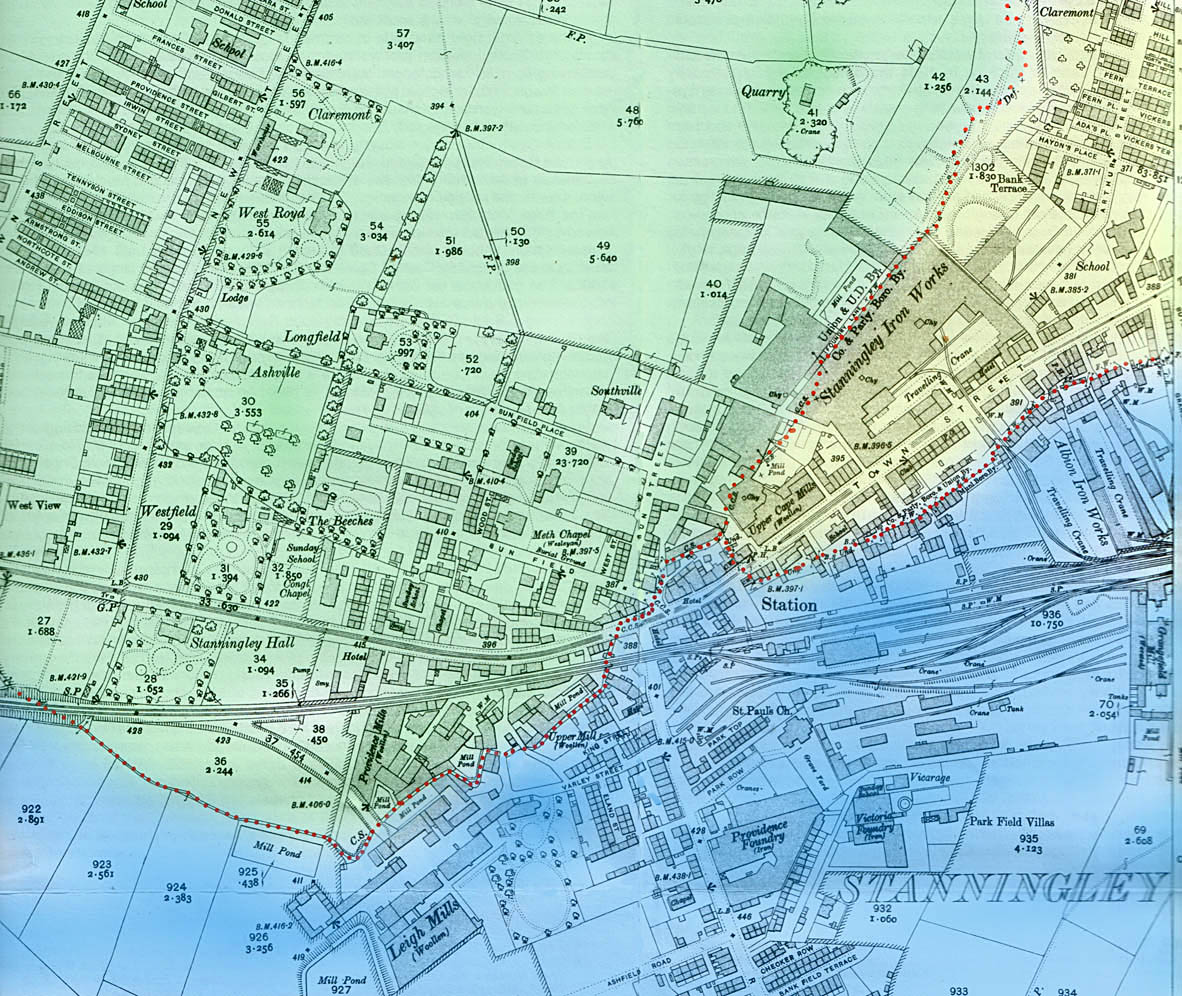
Stanningley is a problematical township because parts of it come under three registration sub-districts, two Parliamentary Boroughs and two ancient parishes. The red dots on the map define the boundaries in Stanningley. Dealing with the parishes first, the parts of the 1906 map (below) in blue and green came under Calverley parish, and events such as marriages and Christenings would be conducted at St Wilfrid's church in Calverley. The part in yellow came under Leeds Parish and events would be conducted at St Peter's in Leeds. The parishes were broken up around 1840 and then each section of Stanningley had its own church, these being St. John in Farsley (green section), St. Thomas in Stanningley proper (yellow) and St Paul in Pudsey (blue). Pudsey already has a parish church (St. Lawrence) so St. Paul's church is usually referred to as St. Paul's Stanningley, which can be misleading. In our pages the church is usually referred to as being in Richardshaw. It must be noted that though these churches all existed from the 1840's, most of Stanningley used the ancient parish churches of Leeds and Calverley for many years afterwards.
Regarding Registration Sub-districts, Stanningley fell under three. Calverley with Farsley, Pudsey with Tyersall and Bramley. To find a relative in the census returns may require examination of more than one piece. Calverley and Pudsey are on the same or following pieces and were in the same Parliamentary Borough and Registration District, which was Bradford, but Bramley is part of Leeds Borough.
In 1841, Stanningley can be found on these separate census pieces:
Calverley with Farsley HO107/1298/2 ED5
Pudsey with Tyersall HO107/1298/13 ED11
Bramley HO107/1342/7 ED1
In 1851, Stanningley can be found on these census pieces:
Calverley with Farsley HO107/2313 ED6
Pudsey with Tyersall HO107/2313 ED20 to 22
Bramley HO107/2315 ED1a
In 1861, Stanningley can be found on these census pieces:
Calverley with Farsley RG9/3345 ED6
Pudsey with Tyersall RG9/3348 ED20 to 22
Bramley RG9/3555 ED17
In 1871, Stanningley can be found on these census pieces:
Calverley with Farsley RG10/4505 ED8
Pudsey with Tyersall RG10/4509 ED22
Bramley RG10/4526 ED5
In 1881, Stanningley can be found on these census pieces:
Calverley with Farsley:
Pudsey with Tyersall:
Bramley RG11/4500 ED4 to ED6
In 1891, Stanningley can be found on these census pieces:
Calverley with Farsley RG12/3655 ED8
Pudsey with Tyersall RG12/3658 ED20 & 21
Bramley RG12/3673 ED4, RG12/3673 ED5, RG12/3674 ED14
In 1901, Stanningley can be found on these census pieces:
Calverley with Farsley RG13/4186 ED8
Pudsey with Tyersall RG13/4188 ED16 to ED19
Bramley RG13/4206 ED8 to ED11
In the 1861 Census for Calverley with Farsley, on the Enumeration District for the Farsley section of Stanningley (RG9/3345 ED6), the enumerator took care to differentiate which part of Stanningley a person was born, but this is a unique example.
For registration purposes, a birth, marriage or death that took place in either the Calverley with Farsley (green) or Pudsey (blue) sections would show as being registered in Bradford (except for the years 1892 to 1937 when both Calverley with Farsley and Pudsey came under North Bierley). The Bramley section of Stanningley (yellow) was in the district of Hunslet until 1862, then in Kirkstall until March 1863, then Bramley until 1904 then as Armley and Bramley until 1925, though at Leeds Register Office the entries are almost always shown in Kirkstall sub-district.
Someone born in Stanningley could show up in any of these district registers, depending when they were born and which side of the road they lived on. Thankfully, all records from all these sub-districts are all together and can be found at Leeds Register Office, not Bradford. There is a very important exception:'Registrar attending' marriages
Before non-conformists churches and chapels were allowed to register marriages that they conducted, a registrar had to be present. This meant that those events were listed as being conducted by the register office of that district. Those marriages that were registered by the churches themselves, are all to be found at Leeds Register Office, while those conducted before, can be found in the records office as listed in the chart below.
Simplified chart, blue records are at Bradford, yellow records are at Leeds:
Non-conformist 'Registrar Attending' Marriages |
||||
Calverley & Farsley |
Bradford District 1837-1891 |
North Bierley District 1892-1937 * |
(both with Pudsey after 1937 ) |
|
Pudsey |
Bradford District 1837-1891 |
North Bierley District 1892-1938 |
Wharfedale District 1939-1974 |
|
Bramley |
Hunslet District 1837-1862 |
Kirkstall District Nov 1862-Mar 1863 |
Bramley District March 1863-1904 |
Armley & Bramley 1905-1925 |
*Calverley and Farsley together until 1894, then seperately, but in same district. |
||||